What Happens When Solar Panels Reach End-of-Life?
Industry News – January 14, 2026
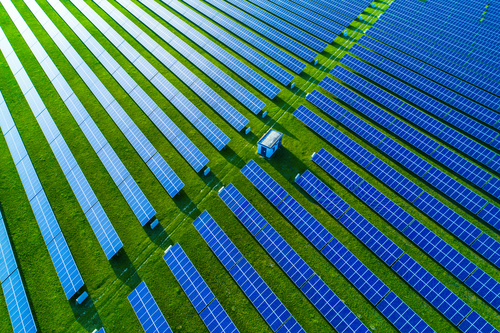
©Valentin Valkov / Shutterstock
Global solar photovoltaic (PV) capacity expanded rapidly over the past decade, increasing from approximately 710 GW in 2020 to about 2,000 GW (2 Terawatts) by the end of 2024. As early installations age, end-of-life management of PV modules is becoming a relevant issue. Most panels are designed for operational lifetimes of 25–30 years.
Cumulative global PV waste is estimated to reach approximately 78 million tonnes by 2050, according to projections by IRENA.
Composition of Solar Panels
A typical crystalline-silicon solar panel consists of multiple material layers:
- Glass (70–80%): Can be recycled into flat or container glass, depending on purity.
- Aluminum (≈10%): Primarily from frames; widely recyclable.
- Polymers (≈10%): Encapsulation and backsheet materials that complicate separation.
- Metals (<1%): Silver, copper, and high-purity silicon.
- Hazardous substances (trace): Lead and cadmium in certain module types, posing environmental risks if landfilled.
Effective recycling requires separation of these layers, particularly the polymer encapsulants.
Relative Scale of Solar Waste
While the projected volume of PV waste is significant, it remains small relative to waste streams from fossil-fuel energy systems. Peer-reviewed studies in the Nature family of journals indicate that coal combustion generates substantially larger quantities of solid waste, including coal ash, on an annual basis. Solar PV waste therefore represents a minor fraction of total global energy-related waste but still requires systematic management due to material value and toxicity considerations.
Regulatory Approaches
- United States: The U.S. Environmental Protection Agency has initiated rulemaking to consider classifying solar panels as Universal Waste under the Resource Conservation and Recovery Act. The process is ongoing, and no final federal timeline has been confirmed.
- India: Solar PV modules are covered under the E-Waste (Management) Rules, 2022. Recent guidelines issued by the Central Pollution Control Board emphasize storage, safe handling, and inventory reporting. Mandatory recycling targets are expected to follow after 2030 as domestic capacity develops.
- European Union: The WEEE Directive assigns extended producer responsibility for PV modules. Since 2018, targets include up to 85% recovery and 80% preparation for reuse and recycling by weight.
Recycling Economics and Capacity
Landfilling a solar panel typically costs USD 1–5 per unit, while recycling costs range from USD 15–25, depending on technology and location. Mechanical recycling recovers glass and aluminum at low cost but leaves residual materials. Thermal and chemical processes enable higher recovery rates, exceeding 90% in advanced systems, including recovery of silver and silicon.
Companies such as SOLARCYCLE are investing in large-scale facilities to improve recovery efficiency and material reuse. Recycling economics remain challenging but may improve as metal prices increase and processing volumes scale.
Outlook
Near-term solar waste volumes will remain limited, but infrastructure and regulatory frameworks are being established in advance of larger end-of-life flows expected after 2040. Recycling capacity, material recovery efficiency, and policy enforcement will determine whether PV waste management evolves into a closed-loop system or remains a cost-driven compliance activity.
References
- IRENA (2025): Renewable Capacity Highlights 2025
- IRENA and IEA-PVPS (2016): End-of-Life Management: Solar Photovoltaic Panels.
- Nature Physics (2023): Unfounded concerns about photovoltaic module toxicity and waste are slowing decarbonization
- U.S. Environmental Protection Agency (2025/2026): Universal Waste Reclassification Rulemaking (RIN 2050-AH32).
- Government of India (2022): E-Waste (Management) Rules, 2022.
- Central Pollution Control Board, India (2025): Draft Guidelines for Storage and Management of Solar PV Waste.
- European Union (2012): WEEE Directive 2012/19/EU on Waste Electrical and Electronic Equipment
- CEEW (2025): Is Solar Module Recycling in India Financially Feasible?.
- Fortune Business Insights (2025): Solar Panel Recycling Market Analysis.