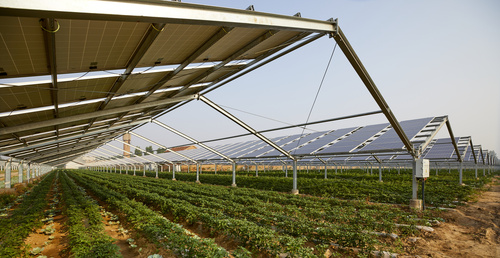
Agrivoltaics—the integration of solar photovoltaic systems with agricultural production—offers a solution to land use competition between renewable energy and food production. Research from multiple countries demonstrates that crop performance under solar panels varies significantly by crop type, panel configuration, and geographic location.
Research shows that shade-tolerant crops maintain or improve yields under agrivoltaic systems. Studies from France found that lettuce production remained stable under partial shading, as these crops adapt effectively to reduced light conditions. Some lettuce varieties even produced higher yields under partial shade compared to full sunlight.
German research at Lake Constance demonstrated that celeriac, winter wheat, and potato yields under elevated solar arrays maintained acceptable production levels while reducing irrigation requirements. The agrivoltaic configuration provided water savings through reduced evaporation.
Research from Arizona on chiltepín peppers, jalapeños, and cherry tomatoes showed substantial benefits in hot, arid climates. Chiltepín fruit production significantly increased under solar panels compared to control plots. Water use efficiency improved considerably for jalapeños and cherry tomatoes. These benefits resulted from cooler daytime temperatures and reduced water loss through evapotranspiration.
However, sun-intensive crops show yield reductions. Studies indicate wheat and corn typically experience lower yields under standard agrivoltaic configurations. Rice cultivation demonstrates significant yield penalties, making agrivoltaics unsuitable for staple grain production without design modifications.
Panel height and spacing critically determine outcomes. Elevated mounting at 4-5 meters with adequate inter-row spacing minimizes crop shading while maintaining viable solar generation. Lower installations maximize energy output per hectare but reduce agricultural productivity.
Agrivoltaic installations typically achieve lower solar energy output per unit area compared to conventional ground-mount systems, depending on panel spacing. Research demonstrates that total land productivity—measured as combined agricultural revenue plus electricity generation—can exceed single-use scenarios when properly designed.
Studies from Germany showed that solar panels under agrivoltaic systems operated cooler than conventional arrays due to evaporative cooling from crops below, improving panel efficiency beyond initial projections.
India has established the Centre of Excellence for AgriPV in collaboration with ICAR-Indian Agricultural Research Institute (IARI) and the National Institute of Solar Energy (NISE). Research indicates agrivoltaic systems can enhance crop yields for suitable crops while reducing water consumption in water-stressed regions.
The Central Arid Zone Research Institute (CAZRI) pilot projects in Jodhpur and Bhuj demonstrated increased land productivity in arid conditions. Several state governments have launched initiatives under the PM-KUSUM scheme framework to promote agrivoltaic adoption, though implementation remains in early stages.
Commercial projects are emerging, with installations in Madhya Pradesh cultivating strawberries, tomatoes, and leafy greens under elevated solar panels. These projects demonstrate technical feasibility but face challenges including higher installation costs compared to ground-mount systems and farmer unfamiliarity with dual-use technology.
Successful agrivoltaic deployment requires crop selection matched to shade tolerance, elevated structures allowing farm equipment access, and panel spacing optimized for local solar angles and crop requirements. The technology performs best in hot, dry climates where crops benefit from partial shading and reduced water stress.
For Indian projects, focus should target high-value horticultural crops and water-stressed regions like Rajasthan and Maharashtra where dual benefits—crop protection and energy generation—justify the cost premium. Berry crops, leafy greens, and certain vegetables offer promising combinations of shade tolerance and economic value.